
When the Funeral Director Is Also a Tech Innovator
It is never easy to talk about death. Whether you are pre-planning or facing a sudden loss, it can feel overwhelming to make decisions during a time that is already heavy with emotion. But what if the funeral space was not just stuck in tradition? What if it evolved with us, meeting grief with grace and pairing compassion with innovation? That is the vision shared by Matthew J. Grieco, a longtime funeral director who is leading a quiet revolution in end-of-life care.
About This Blog
It is never easy to talk about death. Whether you are pre-planning or facing a sudden loss, it can feel overwhelming to make decisions during a time that is already heavy with emotion.
But what if the funeral space was not just stuck in tradition?
What if it evolved with us, meeting grief with grace and pairing compassion with innovation?
That is the vision shared by Matthew J. Grieco, a longtime funeral director who is leading a quiet revolution in end-of-life care.
The Funeral Is Changing, and That Is a Good Thing
Matt has spent over 30 years serving families. He has watched firsthand how funerals have shifted from cookie-cutter ceremonies to highly personalized life celebrations.
Today, fewer people are choosing religious leaders. Instead, many opt for professionally trained celebrants, who tell the story of a life in an emotionally honest way. These ceremonies often include photos, videos, favorite music, and a glass of wine rather than a prayer book.
This shift is not just cultural. It is deeply practical. People want meaning, not formality. They want connection, not obligation.
Why Technology Belongs in the Funeral Home
For Matt, embracing technology is not about abandoning tradition. It is about freeing up time to do what really matters. Being present with families.
He uses tools like Passare, a software platform that helps families submit information online, manage paperwork, and even begin writing obituaries with the help of Ai. This means fewer hours spent behind a desk and more space to guide people through some of their hardest days.
From voice-over-IP(VoIP) systems to video tributes and live-streamed services, every detail is designed to meet modern needs with empathy and efficiency.
Meet EverGrace: The Ai Voice Supporting the Bereaved
But the most groundbreaking part of Matt’s work?
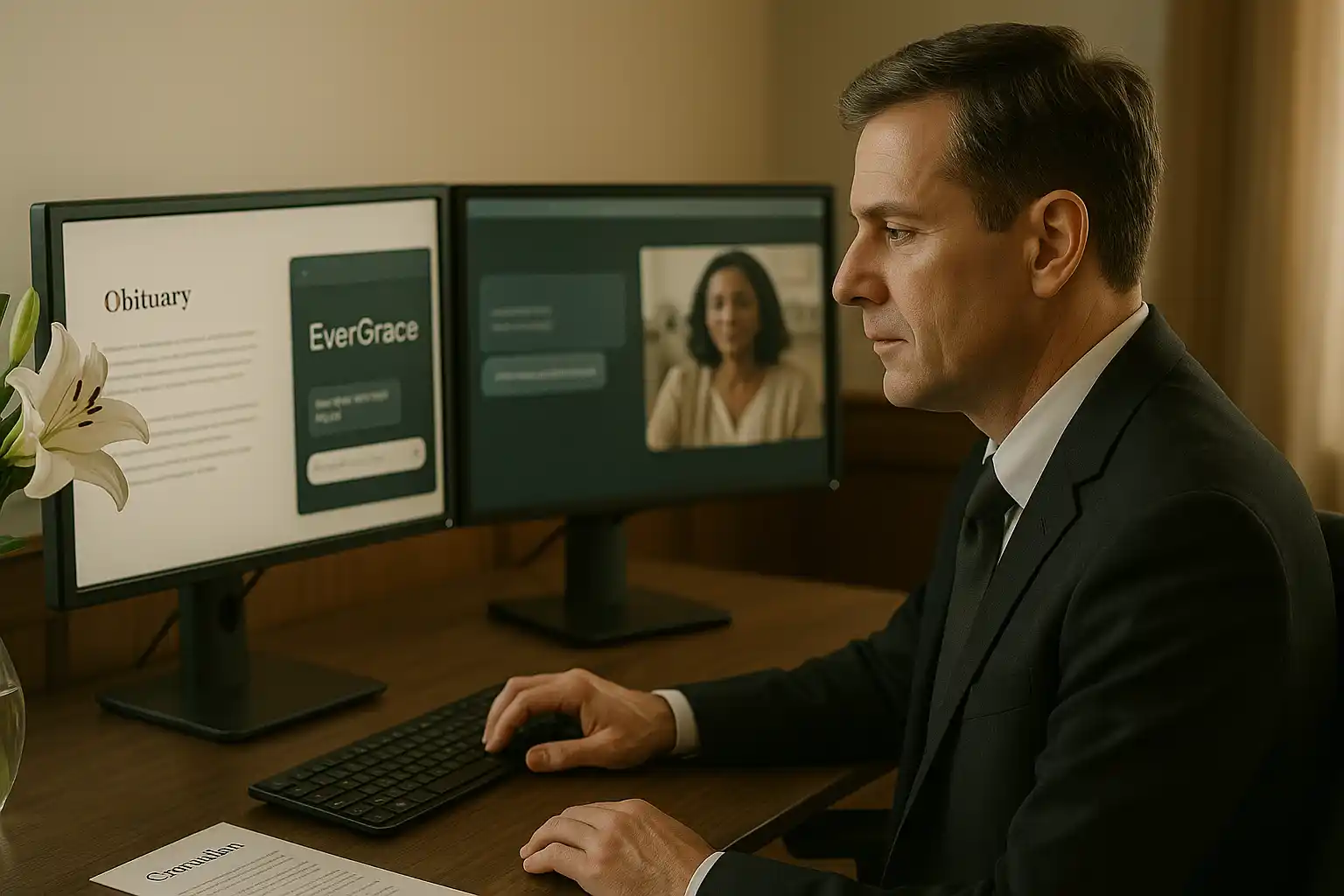
Her name is EverGrace, an Ai-powered voice agent embedded into his funeral home’s website.
EverGrace is not a chatbot in the traditional sense. She speaks. She listens. She can pivot from answering logistical questions to detecting emotional distress and even escalate a call to a human when needed.
She is not there to replace the director. She is there to make that first call less terrifying. The one where you do not know what to say or who to talk to. The one that so many people now make in the middle of the night, not with a phone call but through a website form or email.
EverGrace bridges that gap with gentleness and consistency.
Helping Families, Not Replacing Humans
One thing Matt is clear about is that EverGrace does not eliminate human touch. Instead, she supports it.
She gathers data, answers basic questions, and knows when to hand off the conversation to a real funeral director. Her presence ensures that no email goes unanswered, no request is missed, and every family feels cared for even at 2 a.m.
She learns with every conversation. Her ability to serve improves while guardrails ensure she never goes off-script or gives inaccurate information.
She can even switch languages mid-conversation, such as responding to Spanish without skipping a beat.
Why This Matters More Than Ever
The funeral profession is rooted in 200 years of tradition. But Matt understands that grief is changing. Fewer people have long-standing relationships with their local funeral home. Many younger generations do not even know what a funeral director does.
They search online. They compare prices. They expect transparency.
And most of all, they need support that does not add to the overwhelm.
Technology like EverGrace does not just streamline processes. It allows humans to show up with more empathy, better information, and fewer dropped details.
Where Is the Funeral Industry Headed Next
Matt sees the future as one where funeral homes are less reactive and more proactive. Where Ai supports, but never replaces, the human connection at the heart of this work.
He believes technology can help funeral professionals show up more rested, more present, and more compassionate.
As more families begin to plan ahead, whether for themselves or someone they love. They will need tools that meet them with clarity and care.
Take a Gentle Step Forward
Whether you are pre-planning or navigating fresh grief, you do not have to do it all alone.
Start by having a conversation.
Reach out to a funeral director who embraces both tradition and technology.
Explore what tools like EverGrace can offer when you are not ready to talk to someone just yet.
And most of all, give yourself grace. You are doing the best you can with something no one is ever fully ready for.
🎧 To learn more about how Ai is changing funeral care for the better, watch the full episode with Matthew J. Grieco on The Digital Legacy Podcast.
🌐 Want to see EverGrace in action? Visit evergrace.ai to learn more about the Ai voice agent that is transforming how we connect with grieving families.
Take the Next Step: Start Planning with My Final Playbook


Related Blog
Duis mi velit, auctor vitae leo a, luctus congue dolor. Nullam at velit quis tortor malesuada ultrices vitae vitae lacus. Curabitur tortor purus, tempor in dignissim eget, convallis in lorem.


Comments